Polycode projects · pure JS · no LLM · offline by default · $0
tmct
Ask tmct a question and you get an answer you can check against an open graph. It runs deterministically, offline, in your browser. When it doesn't know, it says so. Nothing calls a model, and it costs nothing to run.
$ npm install -g @polycode-projects/the-mechanical-code-talker
nine easy pieces
Ask it anything, check every answer
The same chat engine as the CLI, running in your browser, deterministically and offline.
chat.html (opens in a new tab) About Ask it anything, check every answerThe same chat, saved to a server session
Switch chat.html's slider to AWS and what you teach it saves to an anonymous server session instead of this browser, gone after seven days.
chat.html (opens in a new tab) About The same chat, saved to a server sessionA feed that only ships what grounds
Fetches nothing until you click start, logs every request on the page, and ranks what it still can't ground.
news.html (opens in a new tab) About A feed that only ships what groundsConcepts rendered using the ontology inheritance
Every shape the site can draw, mapped to the ontology class it belongs to.
sprites.html (opens in a new tab) About Concepts rendered using the ontology inheritanceEvery fact, its source, and how far to trust it
Every fact, where it came from, and how far to trust it.
ledger.html (opens in a new tab) About Every fact, its source, and how far to trust itWatch it solve a puzzle it was taught
Tower of Hanoi solved move by move, with the plan on show as PDDL and OWL artifacts.
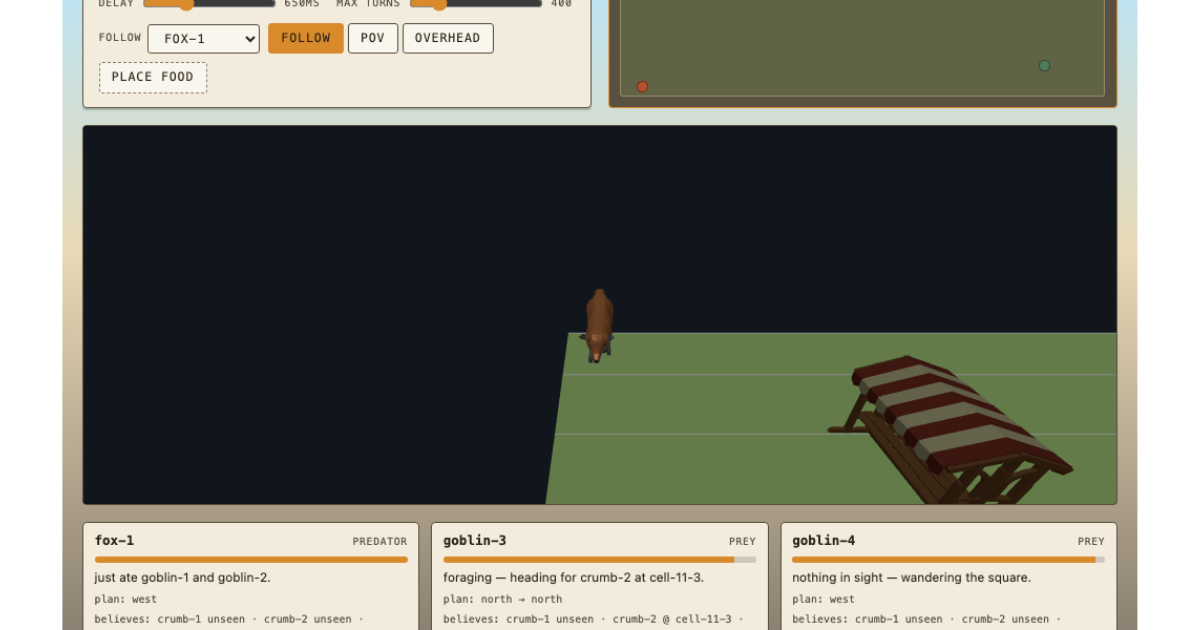
plan.html (opens in a new tab) About Watch it solve a puzzle it was taughtA fox and goblins in a 3D town square
A fox and goblins plan their own moves through a town square, each acting only on what it has seen.
mudiii.html (opens in a new tab) About A fox and goblins in a 3D town squareThe fox, the goat and the cabbage
A farmer ferries a fox, a goat and a cabbage over a river, never leaving anything alone with what eats it. A bounded search finds the seven moves, and the stage plays them one crossing at a time.
mudiii.html (opens in a new tab) About The fox, the goat and the cabbagethe map of the deck
What each demo demonstrates
Seven demos, twelve capabilities between them. A tick means the demo shows that capability. An eye means it is what the demo is for. Nothing in this table calls a model: every tick is deterministic code you can read in the repository, and each demo's own about page says which files back it.
| Demo page | Natural language | Class hierarchy | RDF/OWL triples | Provenance & trust | Graph retrieval | Fact synthesis | Search backed | Classical planning | Multi-agent | Partial knowledge | Fact-driven scene | 3D rendering |
|---|---|---|---|---|---|---|---|---|---|---|---|---|
| chat.html | its focus | yes | yes | yes | its focus | its focus | yes | |||||
| news.html | yes | yes | yes | yes | its focus | |||||||
| sprites.html | its focus | yes | ||||||||||
| ledger.html | yes | yes | its focus | its focus | yes | yes | ||||||
| plan.html | yes | yes | its focus | yes | ||||||||
| mudiii.html | yes | yes | yes | yes | its focus | its focus | yes | its focus | ||||
| adventure.html | yes | yes | yes | its focus |
demonstrates it it is what the demo is for
The real engine, in the page
This is the same chat engine as the CLI, running entirely in the browser: teach it something, ask it something, or run a scripted demo, and it answers from facts it can point at on the graph. The shot here is a real exchange with it; open the full page to try your own.
open chat.html → (opens in a new tab)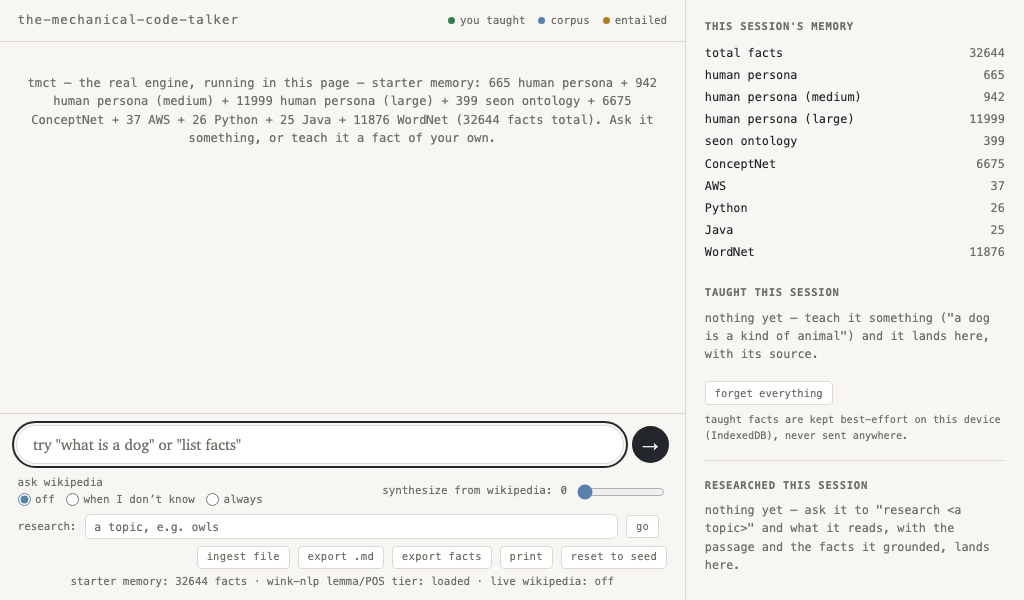 (opens in a new tab)
One question, more than one fact
Some questions do not answer from a single fact. Teach a rule with two
branches, rule one branch out, and /prove works the other
by cases. This is a real exchange with the engine, run before this page
was built, not a mockup.
tmct> every pet is a cat or a dog
noted — remembered 4 facts: cat-or-dog rdf:type class; cat-or-dog owl:unionOf cat; cat-or-dog owl:unionOf dog; pet rdfs:subClassOf cat-or-dog
tmct> rex is a pet
noted — remembered: rex is a pet
tmct> rex is not a cat
noted — remembered: no rex is a cat
/prove is rex a dog
yes — you told me: cat-or-dog is either cat (source: ace:chat:<session-id>@<timestamp>); you told me: rex is a pet (source: teach:chat:<session-id>@<timestamp>); you told me: rex is not a cat (source: teach:chat:<session-id>@<timestamp>); you told me: pet is a kind of cat-or-dog (source: ace:chat:<session-id>@<timestamp>); you told me: cat-or-dog is either dog (source: ace:chat:<session-id>@<timestamp>); in every case — a cat or a dog — rex is a dog.
More on how /classify and /prove work on chat-about.html.
A feed built only from what grounds
Click start and it polls real sources on a timer: a Wikimedia featured-articles feed, Hacker News, USGS earthquakes, and two more you can switch on. Every source it can ground turns into a paragraph of grounded sentences with links back to where they came from. Every term it can't ground yet goes on a ranked list instead.
open news.html → (opens in a new tab)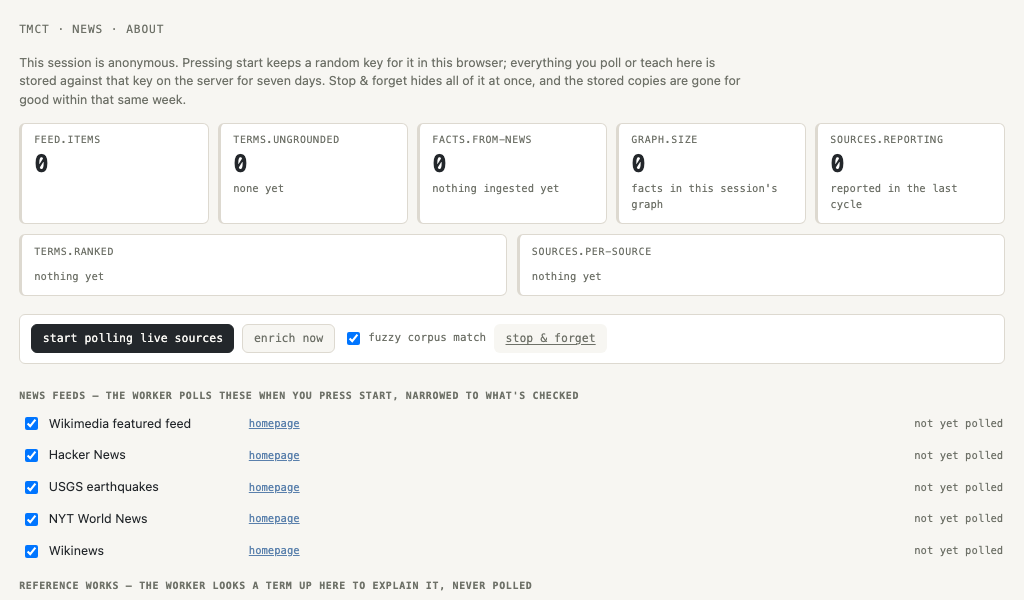 (opens in a new tab)
The feed runs through the same /news command
news.html is a dashboard, but the feed underneath it is one chat command.
Type /news poll in any chat session and it runs the same
poll-ground-rank loop, then reports it as text. This is a real exchange
with the engine, run before this page was built, not a mockup.
/news
no news items yet — poll a source or teach something first.

Goal (inferred): Surface or work the news feed built over this graph.

/news poll
polled 1 source: 2 new items, 1 fact stored, 0 derived, 0 failures, 0 evicted.

Goal (inferred): Surface or work the news feed built over this graph.

/news rank
1. wombat (2) — unknown word
2. marsupial (1) — unknown word
3. nocturnal (1) — unknown word

Goal (inferred): Surface or work the news feed built over this graph.
More on how polling, grounding and ranking work on news-about.html.
The sprite library
Every shape the sprite library can draw, mapped to the real ontology class it belongs to. A term without a sprite of its own borrows its nearest ancestor's, so a poodle draws as a dog.
open sprites.html → (opens in a new tab)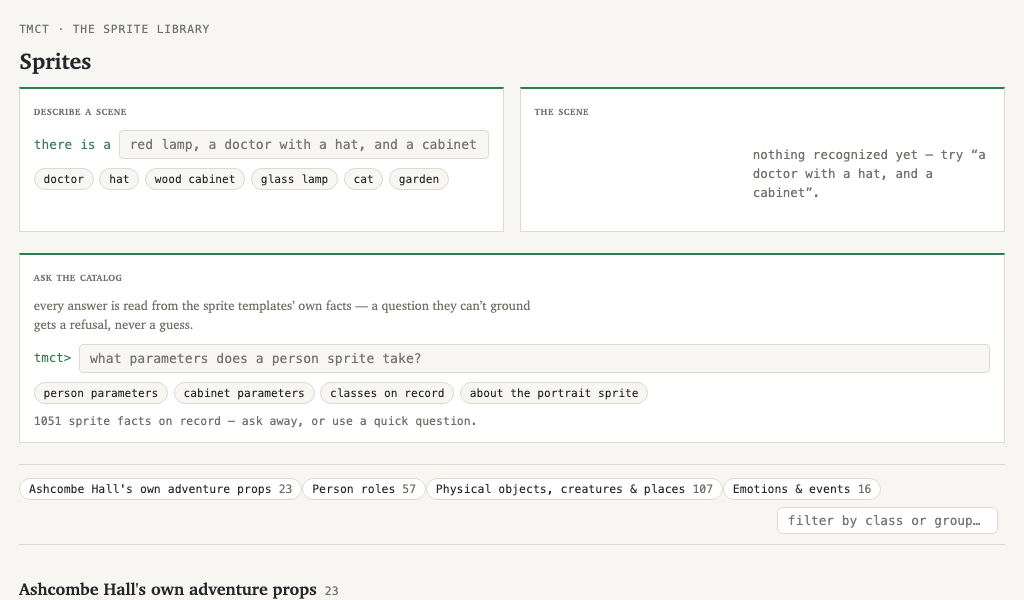 (opens in a new tab)
Grounding a question from Wikipedia
A term the graph has never seen gets an honest miss. Ask it to research the topic and it fetches Simple English Wikipedia, reads the article's opening passage, and stores what it can ground as a fact, cited back to the page it read. This is a real exchange with the engine, run before this page was built, not a mockup.
tmct> what is an aardvark
I don't know "aardvark" yet — teach me directly, e.g. "aardvark is an <thing>" or "remember aardvark is an <thing>".
tmct> research aardvark
aardvark — The aardvark is a mammal from Africa; its name means "earth pig" in the language Afrikaans. It is the only living member in its order, though some fossil genera have been found (source: research article "Aardvark", Simple English Wikipedia, CC BY-SA 4.0 — https://simple.wikipedia.org/wiki/Aardvark?oldid=10916573)
stored 1 fact from "Aardvark". queued 3 linked topics: Africa, Afrikaans, Binomial nomenclature — "research next" fetches the next one (the page's play button does this for you).
tmct> what is an aardvark
i learned: aardvark is a kind of mammal (source: research:aardvark@0)
More on where a live Wikipedia read's trust tier comes from on chat-about.html.
Facts as RDF/OWL triples
Browse the taught graph. Every fact shows its provenance and its trust tier, and every term inside a fact is a link, so you can drill from any answer down to what it rests on. A chat dock lets you teach and ask against the same store.
open ledger.html → (opens in a new tab)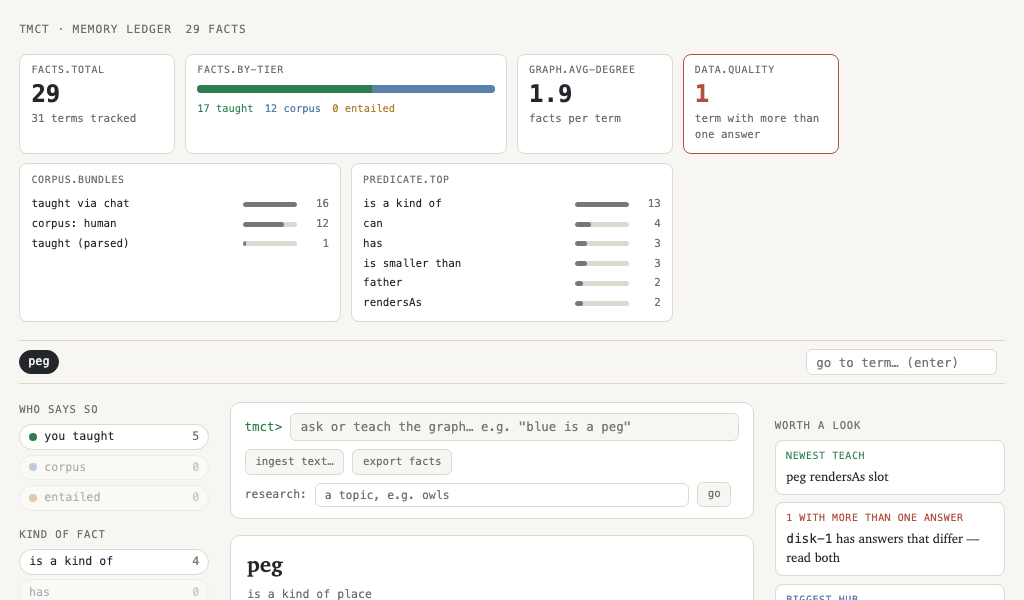 (opens in a new tab)
Classical AI Planning
Teach it a game's rules, then ask it to solve one. The planner replays every move it made, one by one, and a side panel shows the plan as a PDDL artifact and as OWL facts, so you can read exactly what it searched over. Change the disk count and it solves again, live.
open plan.html → (opens in a new tab)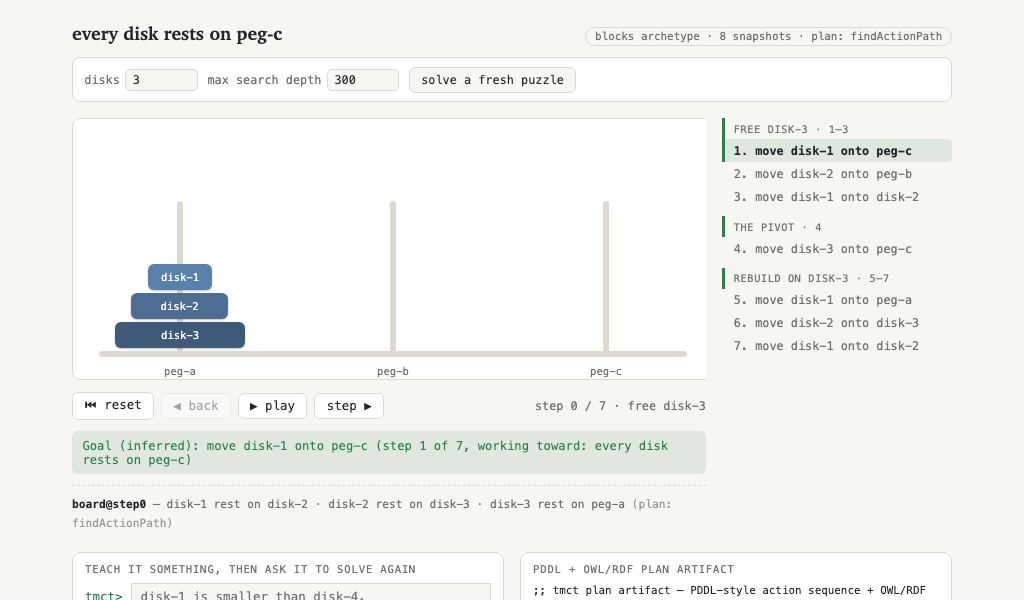 (opens in a new tab)
examples/mini-webapp) using the exact same query engine the CLI
ships. It runs live, client-side. Nothing is precomputed on a server; this
static site has no backend to run it on. The same question against a real repo, from a terminal:
Multiple competing agents
This page runs the same deterministic planner as the other game demos, rendered in three dimensions. A fox and a handful of goblins each plan their own next move across a shared town square. Every one of them only knows what it has personally seen, so a goblin can walk straight into a fox it hasn't spotted. Drop food on the square and watch it change what the goblins do next. A fourth scenario swaps the chase for a logic puzzle: the classic wolf-goat-cabbage river crossing, played here with a fox, solved by the same search, its "may not be left alone" rule derived from the cast's own drives rather than authored twice. No LLM plans any of it.
open mudiii.html → (opens in a new tab)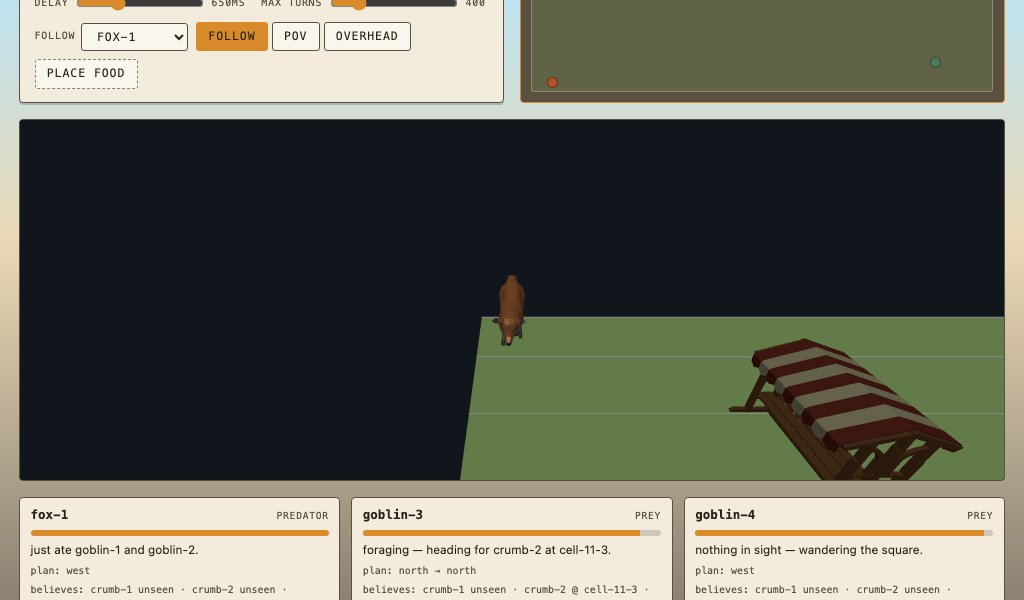 (opens in a new tab)
A room drawn from the text
Ashcombe Hall is a small manor built from its own facts. The room view shows exactly what the text says is there, and nothing else. An auto-player explores the house, infers its own goal, and plays toward it with the same planner the other pages use.
open adventure.html → (opens in a new tab)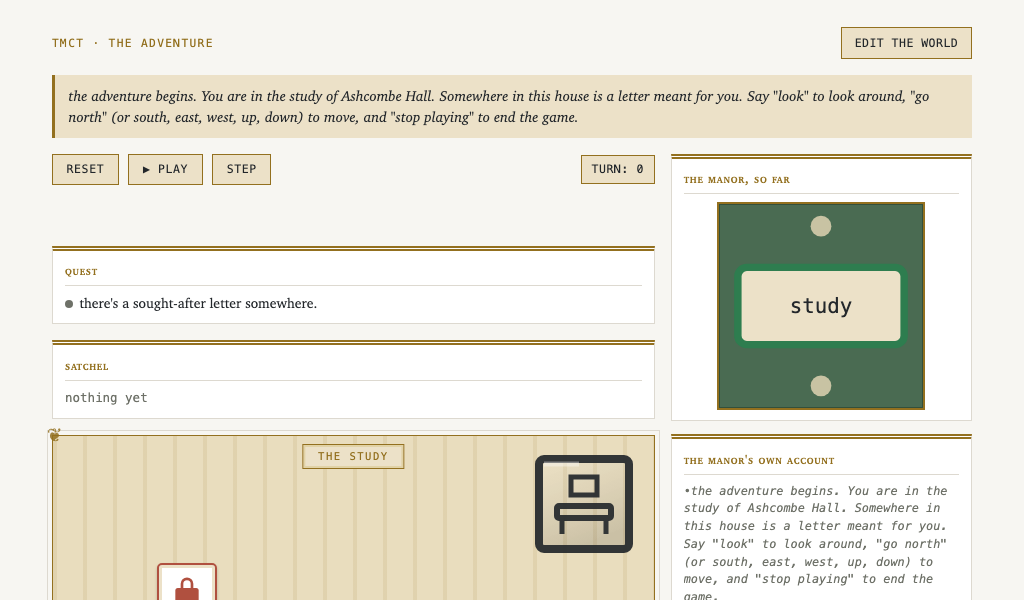 (opens in a new tab)
Run the chat yourself
npm install -g @polycode-projects/the-mechanical-code-talkerPoint it at a repo's graph and ask about the code. This runs against
examples/mini-webapp, which ships in the repo:
tmct> what talks to store.mjs?
src/handlers/tasks.mjs and src/handlers/users.mjs.
tmct> which modules do not import logger?
…
tmct> /exit
Or start with nothing. tmct bootstraps an empty memory and remembers what you
tell it. Use tmct chat --repo /path/to/repo to point it at your own.
tmct init         # scaffold .tmct/, tmct.toml, seed the default persona + provenance
tmct viz          # write the ledger page — see the link below
tmct syllogise    # offline: pre-derive entailed facts (a maintenance job)
Facts don't have to come entirely from teaching. tmct's own corpus already knows a dog can bark; teach it that Rover is a dog and it reasons the rest, citing both facts it chained through:
tmct> Rover is a dog.
noted — remembered 1 fact: rover rdf:type dog

Goal (inferred): Teach/remember a new fact.

Canonical: rover rdf:type dog — fact("rover", "rdf:type", "dog")

tmct> Does Rover bark?
yes — dog can bark (source: corpus:human /r/CapableOf) — via: rover is a dog (source: ace:chat:<session-id>@<timestamp>)
A chatbot in the ELIZA/PARRY lineage, obsessed with software the way PARRY was obsessed with the mafia. Interpretation is mechanical and memory is an OWL-labelled graph on disk. It starts stocked with an everyday vocabulary. Point it at a codebase and it reasons over that too.
Use it as a library
The chat surface is a function. Feed it lines, read the answers, and the same grounding and provenance rules apply.
import { Readable } from "node:stream";
import { runChat } from "@polycode-projects/the-mechanical-code-talker";

await runChat({
  repoPath: "./my-repo",
  input: Readable.from([
    "ahab is the father of john\n",
    "who is the father of john\n",
    "/exit\n",
  ]),
  output: process.stdout,
});
Full feature list, the detailed-answer pipeline, and the rest of the library API in the README.
the project family
Polycode projects
tmct grew out of two sibling Polycode projects, and the wider family is taking up the tmct library in return.
Seonix
seonix.polycode.co.ukOne of the two sibling projects tmct's engine was seeded out of. It is upgrading onto the tmct library now.
Bedrock Meter
gitlab.com/polycode-projects/bedrock-meterAn AWS Bedrock cost-metering proxy for a sibling chat service. It prices every call pre-flight and, at a configured cap, switches that service onto tmct's no-LLM path instead of an outage.
The Quiet Feed
gitlab.com/polycode-projects/the-quiet-feedA read-only feed aggregator that surfaces signal from your existing social connections while filtering noise. It does not post, comment, or interact — it exists to give you back your attention.